Loading
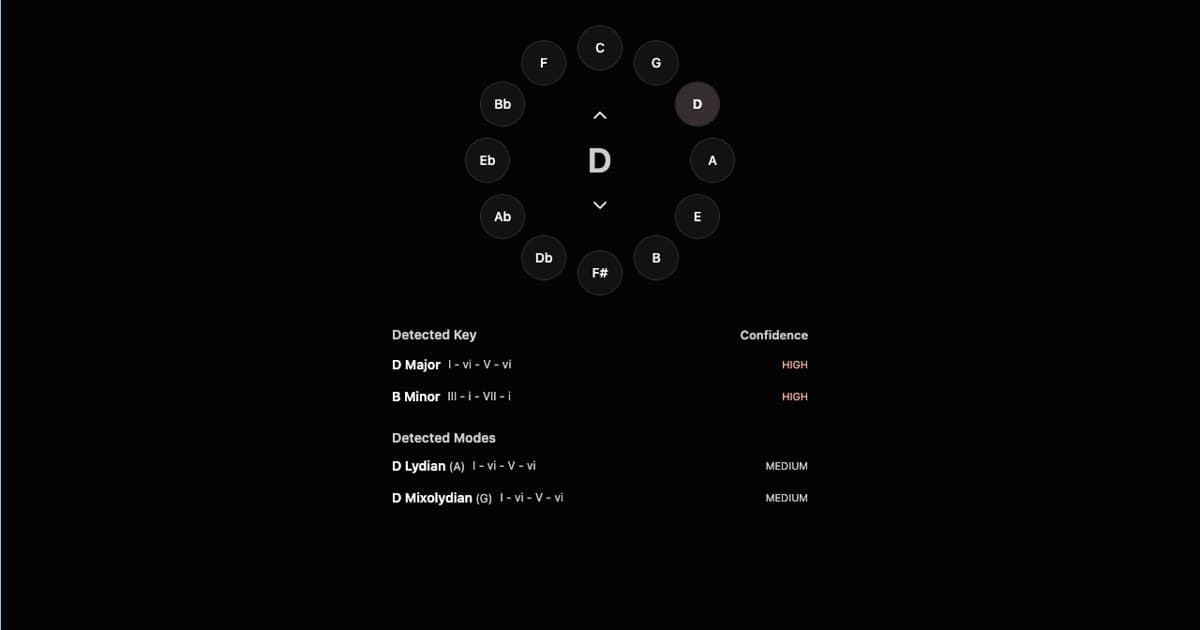
The key of D Major contains seven diatonic chords: D, Em, F#m, G, A, Bm, C#m. Use the interactive generator below to build progressions, hear them played back with drums and accompaniment, and export to MIDI.
The relative minor of D Major is B Minor. Both keys share the same set of notes and diatonic chords, but centre on a different tonic — making B Minor the natural choice for a darker or more melancholic feel.
Every mode below is built from the same seven notes as D Major, starting on a different scale degree.
D Major is a bright, triumphant key that is hugely popular in rock, country, and folk music. The open D and A chord shapes on guitar ring clearly and project well, which is one reason so many acoustic songs are written here.
In classical music, D Major is often associated with grandeur and celebration — Beethoven's Violin Concerto, Handel's "Hallelujah" chorus, and Pachelbel's Canon are all set in this key.
With just two sharps (F♯ and C♯), D Major strikes a balance between brightness and accessibility. Fiddle tunes, bluegrass jams, and campfire singalongs gravitate toward D for the resonance of open strings on violin and guitar alike.
The I–IV–V (D–G–A) is the backbone of country and folk music in this key. The I–V–vi–IV (D–A–Bm–G) powers songs like "With or Without You" by U2. Pachelbel’s Canon follows a I–V–vi–iii–IV–I–IV–V (D–A–Bm–F♯m–G–D–G–A) pattern that has been borrowed by pop writers ever since.
On guitar, the open D (xx0232), G (320003), and A (x02220) shapes ring beautifully and require no barre chords. Adding a capo at the 2nd fret lets you play open C shapes and sound in D. On piano, the two black keys (F♯ and C♯) fall naturally under the 3rd and 4th fingers, making scale runs comfortable.
D Major’s relative minor is B minor, a popular key for rock ballads and film scores. The dominant key (V) is A Major and the subdominant (IV) is G Major — both extremely guitar-friendly keys, which is why songs in D often modulate to G or A without any friction.