Loading
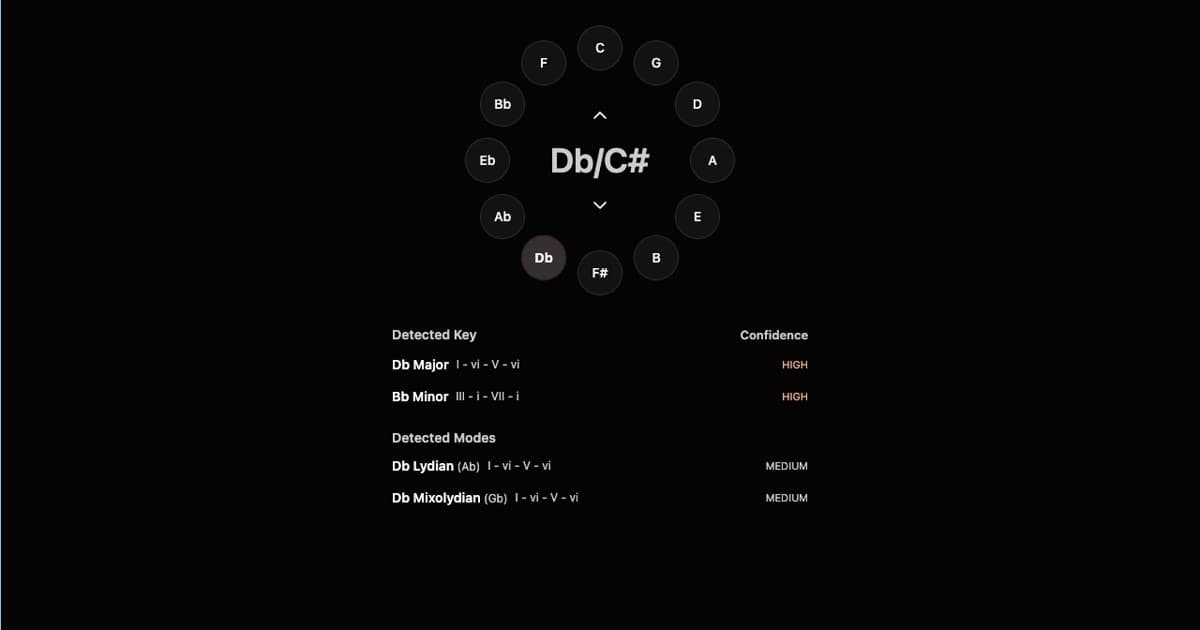
The key of Db Major contains seven diatonic chords: Db, Ebm, Fm, Gb, Ab, Bbm, Cm. Use the interactive generator below to build progressions, hear them played back with drums and accompaniment, and export to MIDI.
The relative minor of Db Major is Bb Minor. Both keys share the same set of notes and diatonic chords, but centre on a different tonic — making Bb Minor the natural choice for a darker or more melancholic feel.
Every mode below is built from the same seven notes as Db Major, starting on a different scale degree.
Db Major (often written instead of C♯ Major for readability — five flats versus seven sharps) is a favourite in R&B, neo-soul, and gospel music. Its lush, warm tonality lends itself to expressive vocal melodies.
On piano, the black-key-heavy layout actually feels natural to many players — the shorter keys sit comfortably under the fingers for legato passages. On guitar, however, most chords require barre shapes, making it a less common choice for acoustic songwriting.
Artists like Stevie Wonder, Alicia Keys, and D'Angelo have all gravitated toward Db Major for its rich harmonic colour and the vocal range it tends to favour.
The I–vi–ii–V (D♭–B♭m–E♭m–A♭) is a classic turnaround in gospel and jazz ballads. Stevie Wonder’s "You Are the Sunshine of My Life" sits in D♭, and the I–IV–V–I (D♭–G♭–A♭–D♭) appears in countless Motown-era arrangements. The ii–V–I (E♭m–A♭–D♭) is a bread-and-butter jazz cadence in this key.
On piano, the thumb naturally rests on the white keys D♭ and A♭ while the longer fingers reach the black keys, creating an ergonomic hand shape. Guitarists who want to play in D♭ without barre chords can capo at the 1st fret and use open C Major shapes, or capo at the 4th fret and play open A Major shapes.
D♭ Major’s relative minor is B♭ minor, a key frequently used in dramatic film scores and minor-key R&B. The dominant key (V) is A♭ Major and the subdominant (IV) is G♭ Major. Moving between D♭ and A♭ is extremely common in soul and gospel music.