Loading
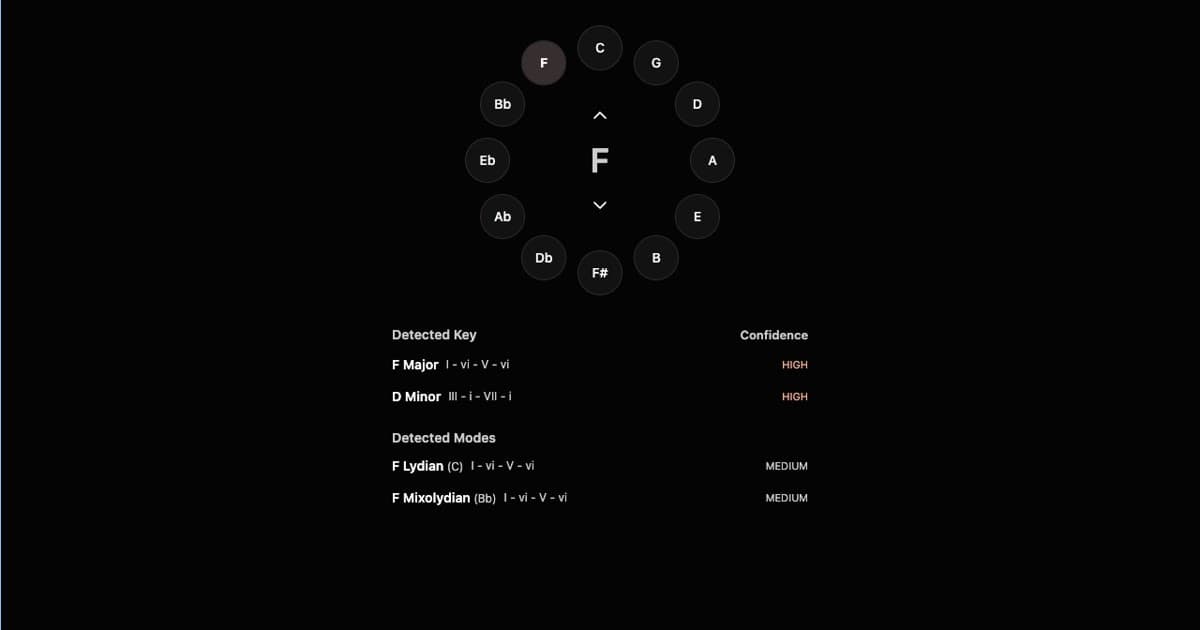
The key of F Major contains seven diatonic chords: F, Gm, Am, Bb, C, Dm, Em. Use the interactive generator below to build progressions, hear them played back with drums and accompaniment, and export to MIDI.
The relative minor of F Major is D Minor. Both keys share the same set of notes and diatonic chords, but centre on a different tonic — making D Minor the natural choice for a darker or more melancholic feel.
Every mode below is built from the same seven notes as F Major, starting on a different scale degree.
F Major is a versatile key with just one flat (Bb). It appears across pop, classical, and film scores, offering a slightly warmer colour than C Major while remaining easy to read and play.
On guitar, the F barre chord is a famous hurdle for beginners — mastering it is often considered a rite of passage. Once past that barrier, F Major opens up a rich palette of voicings.
In orchestral and choral writing, F Major is associated with pastoral scenes and calm emotion. Beethoven's Sixth Symphony ("Pastoral") and many hymns are set in this key, taking advantage of its gentle, grounded character.
The I–IV–V–I (F–B♭–C–F) is a staple in hymns, folk, and early rock and roll. The I–V–vi–IV (F–C–Dm–B♭) powers songs like "Hey, Soul Sister" by Train. The vi–IV–I–V (Dm–B♭–F–C) gives a more wistful feel and appears in tracks like "Apologize" by OneRepublic.
On guitar, the F barre chord (133211) is unavoidable, but the rest of the diatonic chords — B♭ (x13331), C (x32010), Dm (xx0231), Am (x02210) — are manageable. A capo on the 1st fret with open E shapes is a common workaround. On piano, F Major has just one black key (B♭), making it nearly as approachable as C Major for sight-reading.
F Major’s relative minor is D minor, one of the most frequently used minor keys in classical and pop music. The dominant key (V) is C Major and the subdominant (IV) is B♭ Major. The close relationship with C Major means many songs shift between the two keys effortlessly, often using the shared Am and Dm chords as pivot points.