Loading
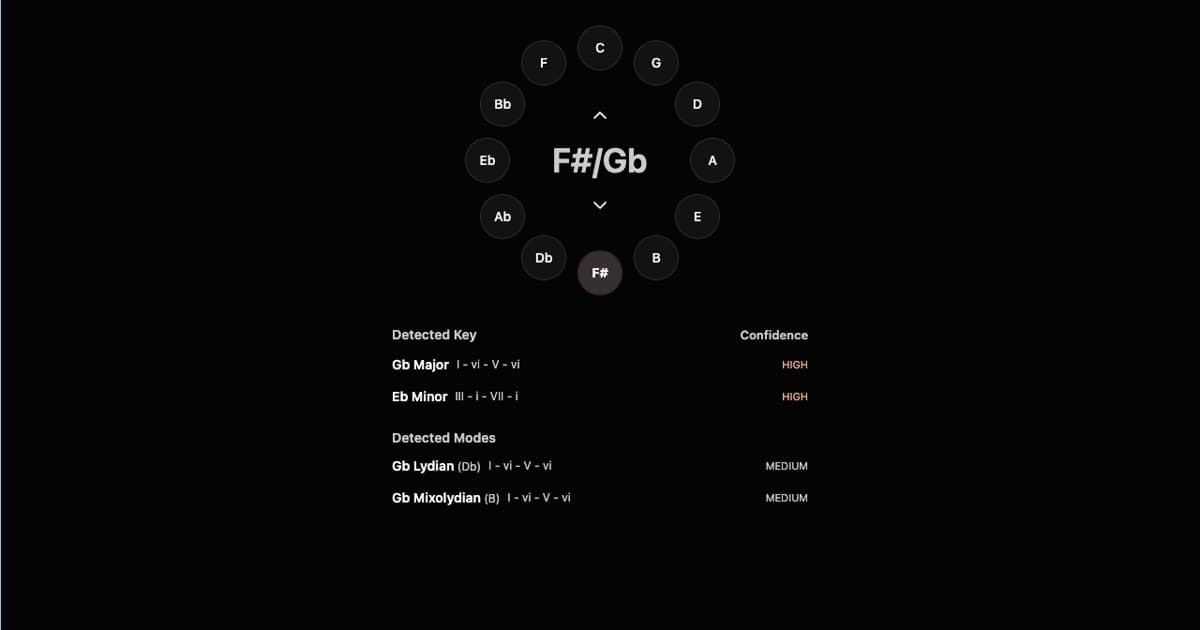
The key of Gb Major contains seven diatonic chords: Gb, Abm, Bbm, B, Db, Ebm, Fm. Use the interactive generator below to build progressions, hear them played back with drums and accompaniment, and export to MIDI.
The relative minor of Gb Major is Eb Minor. Both keys share the same set of notes and diatonic chords, but centre on a different tonic — making Eb Minor the natural choice for a darker or more melancholic feel.
Every mode below is built from the same seven notes as Gb Major, starting on a different scale degree.
Gb Major (or F♯ Major) is one of the less common keys, carrying six flats (or six sharps). Its rarity gives it a distinctive, almost exotic colour that composers and songwriters use for special effect.
On piano, Gb Major places most notes on black keys, creating a unique tactile feel. Some pianists find this layout surprisingly comfortable for certain passage types, especially rapid scalar runs.
Progressive rock, art pop, and jazz occasionally venture into Gb Major to break away from more predictable tonal centres. When it appears, it tends to grab the listener's ear precisely because it sounds unfamiliar.
The I–IV–V (G♭–C♭–D♭) provides the basic framework, though in practice many writers think of this enharmonically as F♯–B–C♯. The I–V–vi–IV (G♭–D♭–E♭m–C♭) works for pop writing, and Chopin’s "Black Key" Étude (Op. 10 No. 5) is the most famous classical piece centred on this tonality.
On piano, the five black keys under the fingers create a pentatonic-like hand position that many players find intuitive for improvisation. On guitar, G♭ Major is awkward in standard tuning — the most practical approach is to capo at the 2nd fret and use open E shapes, or tune down a half step and play open G shapes. In F♯ Major spelling, a capo at the 2nd fret with E shapes is the standard choice.
G♭ Major’s relative minor is E♭ minor (enharmonically D♯ minor), a key Chopin used to great effect. The dominant key (V) is D♭ Major and the subdominant (IV) is C♭ Major (enharmonically B Major). These enharmonic overlaps mean G♭ often serves as a gateway between flat-key and sharp-key territory in more adventurous compositions.